Main Page
From SolarSailWiki

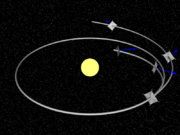

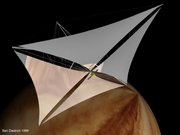




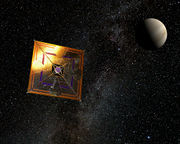

Sunlight pushes gently on spacecraft with large, lightweight, mirrored solar sails. They enable travel throughout the solar system and beyond without rocket propellant. SolarSailWiki covers everything from the science of light pressure, what they can do for us, to technologies and missions of the future.
Please help SolarSailWiki become a comprehensive source of solar sail information. Ask for an account by sending an email to admin at solarsails dot info.
Solar Sail News
- LightSail has deployed
- The Planetary Society's LightSail spacecraft successfully deployed its solar sail. The link includes instructions on how to view the spacecraft using the N2YO service. The deployment comes after the mission struggled with a software glitched caused a communications loss and battery problems. Also see the Planetary Society's press release. Congratulations, LightSail team! --Ben (talk) 17:47, 7 June 2015 (EDT)
- (Sun, 07 Jun 2015 17:47:33 -0400)
- LightSail Team Prepares for Sail Deployment
- The LightSail team is preparing to run the deployment test of the solar sail on Wednesday June 3rd, 2015. Deployment will be executed manually, and is happening shortly after the team resumed communications with the LightSail spacecraft. There was an 8 day communications blackout due to a glitch in the software. --Ben (talk) 14:19, 1 June 2015 (EDT)
- (Mon, 01 Jun 2015 14:19:50 -0400)
- StarTalk Cosmic Queries: LightSail with Bill Nye
- Bill Nye answers questions about solar sails and LightSail on the April 19th, 2015, episode of StarTalk Radio. --Ben (talk) 14:04, 1 May 2015 (EDT)
- (Fri, 01 May 2015 14:04:30 -0400)
- LightSail Readiness Tests Prepare Team for Mission Operations
- The Planetary Society's LightSail mission is undergoing tests to make sure the spacecraft is ready for operations when it launches. LightSail is scheduled to launch no sooner than May 20th 2015, on an Atlas V rocket with the Air Force's X-37B reusable spaceplane. --Ben (talk) 13:48, 25 April 2015 (EDT)
- (Sat, 25 Apr 2015 13:48:04 -0400)
- Project Dragonfly on Kickstarter
- Project Dragonfly is a proposal to launch a swarm of small solar sails to the stars using lasers. They have launched a Kickstarter fundraising campaign for the preliminary engineering design by international student teams. --Ben (talk)
- (Sat, 25 Apr 2015 13:29:43 -0400)
- Dreaming Up the Future of Interstellar Travel
- Science Friday interviews Les Johnson about the future of interstellar travel. --Ben (talk) 13:02, 25 April 2015 (EDT)
- (Sat, 25 Apr 2015 13:02:22 -0400)
- NASA Nixes Sunjammer Mission, Cites Integration, Schedule Risk
- Space News reports on the cancellation of NASA's solar sail demonstration mission (Sunjammer). Fair winds, LightSail. --Ben (talk) 20:33, 18 October 2014 (EDT)
- (Sun, 19 Oct 2014 09:51:52 -0400)
- LightSail updates July 7, 2014
- The Planetary Society's LightSail solar sail cubesat mission has posted some recent updates, including a major announcement. LightSail is Ready for Launch! Join Us as the Countdown Begins. Live webcast and major announcement Wednesday July 9th, 2014 LightSail update: Of booms and pretty pictures, July 1, 2014 LightSail update: Three steps forward, one step back, June 18, 2014 --Ben (talk) 18:41, 7 July 2014 (EDT) Updates: LightSail is scheduled to launch on a SpaceX Falcon Heavy in April of 2016. The Planetary Society blog post about the LightSail launch. LightSail-A may fly in May of 2015 in a LEO test before flying LightSail-B high enough to sail in April 2016. LightSail-B will fly with the Prox-1 nanosatellite mission which will image LightSail. --Ben (talk) 22:38, 9 July 2014 (EDT)
- (Mon, 07 Jul 2014 18:41:10 -0400)
- Solar sail news roundup for October 3, 2013
- It's been awhile since I posted on news in the world of solar sailing, so here's a list of stories that have come out in the past several months. Sunjammer The Sunjammer project successfully tested deployment of a sail quadrant at a L·Garde facility in Tustin, CA, on September 30th, 2013. This is one boom and one sail out of four that will make up the flight sail. Students from the Palm Middle School Science, Technology, and Mathematics (STEM) program visited L'Garde and watched the deployment test. News Coverage Universe Today: Huge Solar Sail Portion Unfurls In Crucial Ground Test Satnews: L'Garde Inc., Space Services Holdings + NASA - Sunjamming For Power (Technology-Sail) NBC News, September 23, 2013: Solar sail ships seen as best bet now to get us to interstellar space. Discussion with physicist and novelist Dr. Gregory Benford on interstellar travel. Project Forward of Icarus Interstellar continues the study of beamed sail propulsion to other stars. Infographic on interstellar sailing IKAROS The IKAROS sailcraft is still alive and orbiting the sun with occasional radio beacon contacts with the ground. English translation of IKAROS blog posts: IKAROS Daily Report - August 29th, 2013 IKAROS Daily Report - August 22nd, 2013 The CubeSail project and UltraSail concept of UIUC and CU Aerospace were featured in NASA Tech Briefs on September 1st, 2013: UltraSail CubeSat Solar Sail Flight Experiment. The Third International Symposium on Solar Sailing was held on June 11-13th, 2013, at the University of Strathclyde in Glasgow, Scotland. --Ben (talk) 14:30, 3 October 2013 (EDT)
- (Thu, 03 Oct 2013 14:30:24 -0400)
- NASA to Launch World's Largest Solar Sail in 2014
- NASA to Launch World's Largest Solar Sail in 2014 by Leonard David of Space.com goes in depth on the Sunjammer mission. --Ben (talk) 20:19, 25 February 2013 (EST)
- (Mon, 25 Feb 2013 20:19:27 -0500)

